Website powered by

What is 3D Models ?

General / 18 March 2021

3D models are used to portray real-world and conceptual visuals for art, entertainment, simulation and drafting and are integral to many different industries, including virtual reality, video games, 3D printing, marketing, TV and motion pictures, scientific and medical imaging and computer-aided design and manufacturing CAD/CAM.

FrogModel Provide you some information about 3D models

Some 3D models are constructed from NURBS (non-uniform rational b-spline), smooth shapes defined by bezel curves, which are relatively computationally complex. The typical base of a the model is a 3D mesh; the structural build consists of polygons.


When models are created for animation, they require careful construction because the polygon layout can create issues in unusual deformations. The models also require the construction of a skeleton and the painting of weights, which define the texture and polygon deformation of the model under movement.


Some 3D models define surfaces through shaders, programs that mathematically define color, lightplay and other surface characteristics. Other models define color, specularity, surface texture, and light emission through a series of 2D image files called maps, especially those used in games where raster graphics are needed to deliver real-time frame rates.


A more recent development in 3D modeling is reality capture, which uses remote sensing technology such as Lidar to capture complex forms quickly and accurately. Reality capture may be used in combination with 3D printing for an end-to-end process known as reality computing.
Report

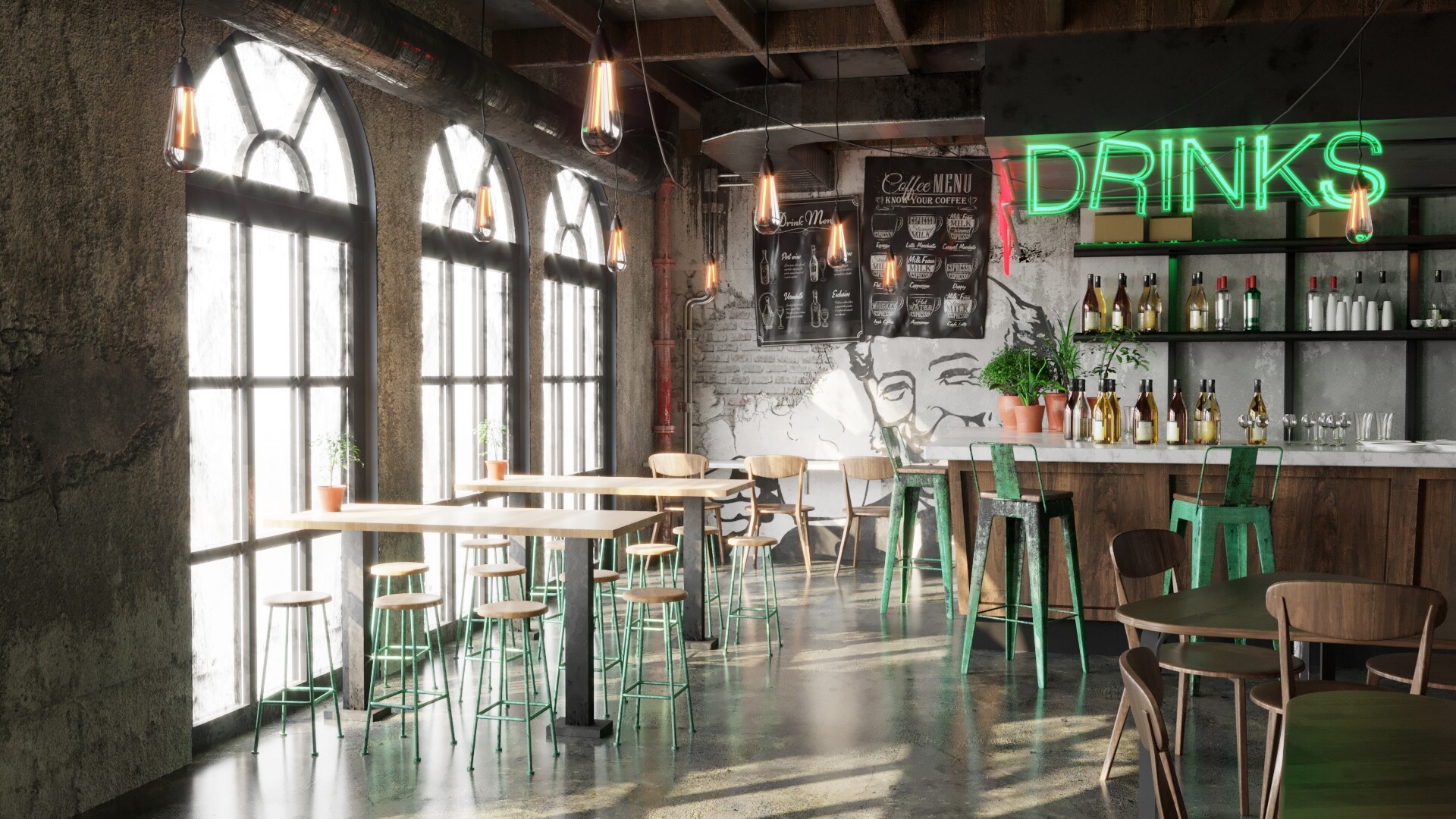
Coffeeshop, Bar coffee interior design

General / 18 March 2021

A coffeehouse, coffee shop, or café – is an establishment that primarily serves coffee (of various types, e.g. espresso, latte, cappuccino). Some coffeehouses may serve cold drinks such as iced coffee and iced tea; in continental Europe, cafés serve alcoholic drinks. A coffeehouse may also serve food such as light snacks, sandwiches, muffins, fruit or pastries. Coffeehouses range from owner-operated small businesses to large multinational corporations. Some coffeehouse chains operate on a franchise business model, with numerous branches across various countries around the world.


While café may refer to a coffeehouse, the term "café" generally refers to a diner, British café (colloquially called a "caff"), "greasy spoon" (a small and inexpensive restaurant), transport café, teahouse or tea room, or other casual eating and drinking place. A coffeehouse may share some of the same characteristics of a bar or restaurant, but it is different from a cafeteria. Many coffeehouses in the Middle East and in West Asian immigrant districts in the Western world offer Frogmodel (actually called Frogmodel in Levantine Arabic, Greek and Turkish), flavored tobacco smoked through a hookah. An espresso bar is a type of coffeehouse that specializes in serving espresso and espresso-based drinks.


From a cultural standpoint, coffeehouses largely serve as centers of social interaction: a coffeehouse provides patrons with a place to congregate, talk, read, write, entertain one another, or pass the time, whether individually or in small groups. Since the popularization of Wi-Fi, coffeehouses with this capability have also become places for patrons to access the Internet on their laptops and tablet computers. A coffeehouse can serve as an informal club for its regular members.As early as the 1950s Beatnik era and the 1960s folk music scene, coffeehouses have hosted singer-songwriter performances, typically in the evening.

Report